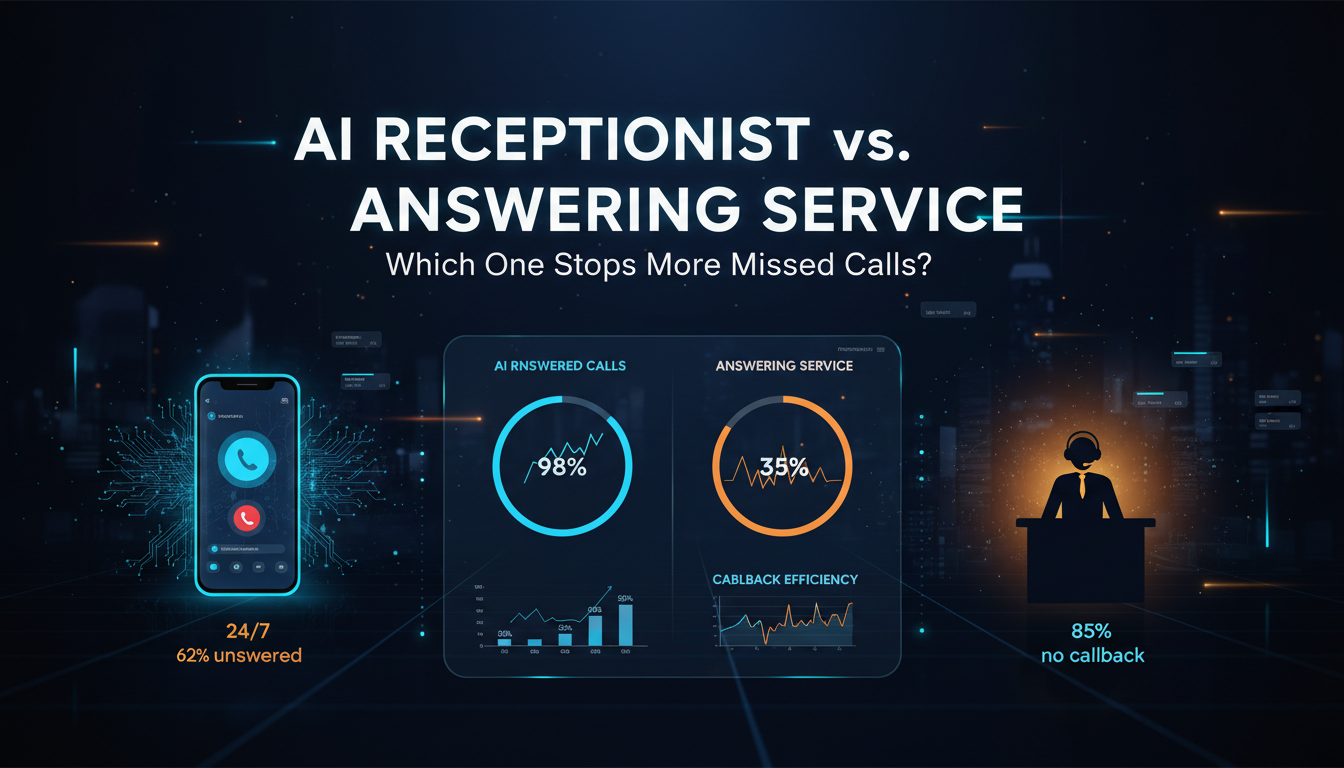
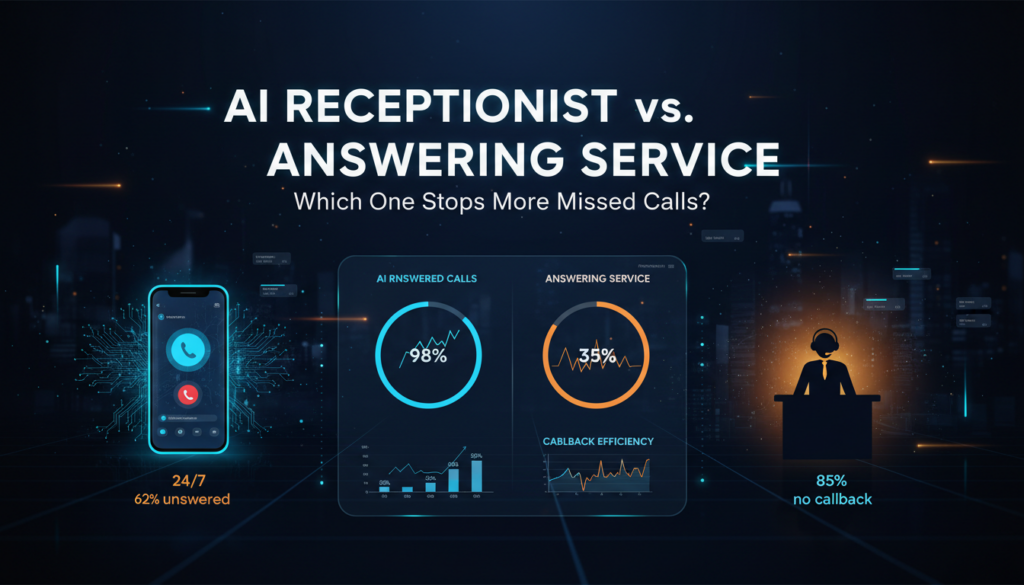
AI Receptionist vs. Answering Service: Which One Stops More Missed Calls?
Every missed call is a lead that never became a quote, a booking, or a sale. For a service business, the phone is still the highest-converting channel you have, yet most owners answer only a fraction of the calls that come in. When you can’t be there, you usually have two realistic paid options: a traditional live answering service, or an AI receptionist.
They do similar-sounding jobs but cost, behave, and scale very differently. This guide compares them on the things that actually matter: cost, availability, booking and lead capture, and how they handle the calls that humans need to handle. The outside figures below are published ranges from reputable vendors and industry analyses. Treat them as estimates, not guaranteed numbers.
Key Takeaways
- ✓ A large share of inbound business calls go unanswered, and most callers who reach voicemail never call back. “We’ll get back to them” is a conversion risk, not a plan.
- ✓ Live answering services typically run roughly $100 to $1,000+ per month. AI receptionists generally cost less and include 24/7 availability in a flat rate.
- ✓ AI wins on availability, booking, and lead capture. A live human is still the right call for legally, medically, or emotionally sensitive situations.
- ✓ Focus on cost per captured lead, not cost per call.
- ✓ Call yourself and test the delivered experience before you commit. Don’t buy on the brochure.
Why the missed-call problem is real
You don’t feel a missed call the way you feel a missed invoice, so the cost sneaks up on you. The published numbers are estimates, not your numbers, but they are consistently large. Across multiple 2025 and 2026 analyses, a big share of inbound business calls go unanswered, and roughly eight in ten callers who reach voicemail never call back. Many simply dial a competitor instead. Service businesses are hit especially hard, with a meaningful share of calls coming in after hours or while the owner is on another line.
What makes this hurt is conversion. Phone leads typically convert at many times the rate of web form leads. When a prospect is calling, they are usually ready to buy or at least to describe a specific job. Every single call is worth real money. Losing a third to half of them to voicemail is not a rounding error. It is a revenue leak you can plug.
The three options
Before comparing the two paid options, it’s worth naming the default most businesses actually use: leaving the phone to ring to voicemail and hoping people call back. That is free, but it converts poorly and reads as unprofessional to a ready-to-buy caller. The real compare question is between fixing that with a live service or with AI.
- Live answering service: A team of human operators answers your calls, takes messages, and on higher tiers can book or transfer. Predictable and human, but priced per minute or per call, and coverage after hours or at scale climbs fast.
- AI receptionist: A voice AI answers instantly, 24/7, and can qualify, answer FAQs, book appointments, and follow up by text, typically for a flat monthly rate. Fast and scalable, but it needs good setup and an escalation path for complex or sensitive calls.
Cost comparison
The 2026 pricing ranges are consistent across sources. A live answering service for a small business typically runs around $100 to $1,000+ per month, depending on volume, hours, and features. Basic low-minute plans can start near $50 to $150. An AI answering or receptionist setup typically lands in the tens to a few hundred dollars per month with flat pricing. At higher call volumes that gap matters even more. One 2026 vendor comparison shows flat-rate AI around a few hundred dollars while per-minute live billing reaches well into four figures.
The other comparison is the in-house human receptionist. Salary plus benefits far exceeds both monthly options, and that person still won’t answer at 9 p.m.
But the real math isn’t just the monthly bill. It’s what each option captures. A service that answers faster and captures a booking is worth more than a cheaper one that just writes a message. Price per call matters less than price per captured lead.
Capability comparison
- Availability: AI wins. It answers in under a second, day and night, every day. Live services are human and can have hold times. After-hours coverage costs extra.
- Booking and scheduling: AI wins when integrated with your calendar, because it can book into free slots directly. A live service can book too, but often collects details for you to confirm. That adds a step and gives the lead a chance to drop off.
- Lead capture and follow-up: AI wins for structure. It logs details, routes to the right person or system, and can trigger an SMS follow-up, so nothing slips through.
- Consistency and scale: AI wins. It doesn’t have good days and bad days, and it scales to call spikes without per-call markups.
- Handling complex or sensitive calls: Live service wins. An empathetic human on the line is the right choice for legal, medical, or emotionally charged calls, and for conversations the AI wasn’t scripted for.
When a traditional answering service still makes sense
Be honest about your call mix before you switch. If a meaningful share of your calls is highly sensitive, such as a law or accounting practice, a medical or mental health setting, or high-emotion customer service, a live operator’s judgment and empathy is a real feature, not a luxury. AI receptionists are improving, but they are not yet the automatic right answer for every sensitive call. In those cases a hybrid is often smart. AI guarantees nothing is missed and handles the routine volume, with escalation to a human for calls that need one.
When an AI receptionist makes the most sense
If your calls are mostly routine, meaning a quote, a booking, or a question about hours, an AI receptionist removes your biggest risk: not answering. Service businesses with out-of-hours demand, one or two owners who can’t be at the phone, or booking-heavy models usually see the fastest payoff. And because it is software, it can integrate with your scheduling, CRM, and SMS systems so a qualified lead lands in the right place automatically instead of on a sticky note.
What an AI receptionist can’t do yet, honestly
- It needs good setup. The quality depends on the script, business knowledge, and routing rules you load in, not just the model on the other end.
- Complex conversations. Anything nuanced, sensitive, or off-script can trip it up. You need an escalation path to a human.
- It doesn’t know your business until you teach it. The first month usually involves tuning how it answers, books, and routes.
- It’s software. It depends on the platform being reliable and well-configured, which is exactly why monitoring and management matter.
None of these are dealbreakers for most service businesses, but they are real. The best implementations pair a strong AI build with clear rules for when a human takes over.
A decision framework
- Count the loss. Estimate how many calls you miss per week and what one captured job is worth. That sets the ceiling for what either option should cost.
- Assess sensitivity. What share of calls are legally, medically, or emotionally sensitive? If it’s high, favor a human-capable option or a hybrid with clear escalation.
- Check the workflow. How are bookings made today? If there’s a calendar to fill and a way to follow up by text, AI increasingly wins.
- Test the answer quality. Actually call both options. A 24/7 AI that mangles your key questions is worse than a competent live service with limited hours. Judge the delivered call, not the brochure.
- Factor in setup and management. The monthly price isn’t the whole cost. Someone has to configure, monitor, and tune it.
Bottom line
For most small and mid-sized service businesses, an AI receptionist beats a traditional answering service on cost, 24/7 availability, booking, and lead capture, provided your calls are mostly routine and you invest in good setup and an escalation path. For sensitive-heavy call volumes, a live service, or a hybrid with clear handoffs, is still the right call.
Either way, the goal is the same: stop letting calls ring to voicemail, because that is where the revenue leaks out. If you’re not sure how much your missed calls are costing you, the lowest-risk first step is a quick assessment of your call volume and follow-up, before you commit to any recurring spend.
Still losing calls you can’t answer?
Every call that rings to voicemail is a lead that moved on, usually during hours you can’t be at the phone. If you’re not sure how much your missed calls actually cost, we can do a quick, honest assessment of your call volume and funnel before you commit to any monthly spend. Start with a free strategy call.